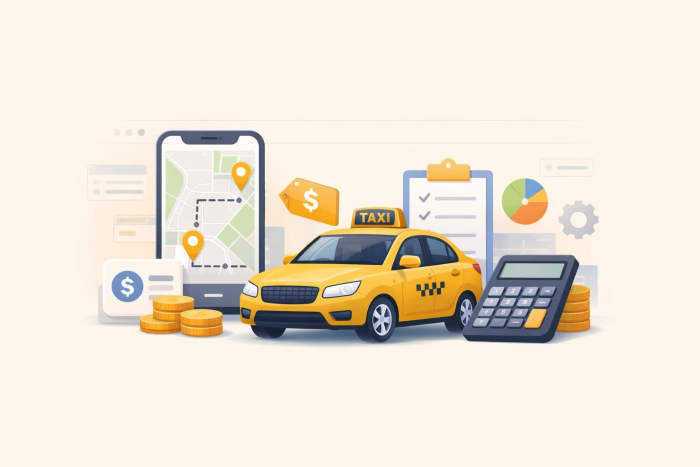
As the owner of a taxi company, you’re always looking for ways to grow your business. And you know that many customers like the convenience of ordering rides online — it’s why you have a website. But you haven’t built an app yet. Truth be told, you worry about the cost. Is developing a taxi app expensive?
It depends. Taxi app development costs can vary widely based on factors like features, complexity, and operating system (OS) compatibility. Basic apps can cost less than $20,000 to build, while more advanced ones can reach into the six figures.
In this guide, we’ll explore what goes into creating a taxi app, average development costs, and an alternative solution that can save you money.
Types of taxi applications
Taxi apps fall into two categories based on your business type.
Dedicated taxi booking app
If you own a taxi company with a fleet of vehicles and drivers, you’ll want a dedicated taxi booking app. This type of app allows customers to book a ride directly with your company.
A dedicated taxi app can support advanced reservations and on-demand bookings. To request a ride, the customer inputs their pickup location, destination, and personal information. The app then connects the customer with an available driver.
Dedicated taxi apps build brand awareness and improve the customer experience. Instead of calling your company to arrange a ride, bookings are handled entirely online, reducing friction in the booking process. You can encourage new customers to download the app through targeted ads and word of mouth.
Taxi aggregator app
Taxi aggregator apps follow a business model that’s similar to Uber or Lyft. They serve as a platform that individual drivers or taxi companies can join and offer rideshare services.
Unlike a dedicated taxi app, the administrator of a taxi aggregator app doesn’t own a fleet of vehicles or manage employees. It earns money through service fees that it collects on each ride. The remaining fares are distributed to drivers.
You can create a simple taxi aggregator app where users can find drivers and call for a taxi. This solution is cheaper to create, since it isn’t complex. Or, you can opt for an on-demand aggregator app that connects available drivers with customers who need an immediate ride. This will require more investment, but includes far more features.
Core components that determine on-demand taxi booking app costs
A taxi app has three main components, each serving either the needs of customers, drivers, or administrators. Here’s a look at each element, what they include, and how much they may cost to create.
App for riders
The customer-facing app connects passengers with available drivers. It can include
- User registration and login: Allows customers to create or access their profile. The profile contains the user’s contact information, preferred settings, and payment details.
- Booking options: Used to choose a cab type based on the number of passengers or specific travel needs.
- Payment gateways and alternatives: Provides customers with payment options for their trip. Some taxi apps support in-app payments.
- Real-time GPS tracking: Shows customers the current location of their taxi before and during the ride.
- Automatic fare calculation: Displays the total cost of the ride based on the customer’s pickup location and destination.
- Notifications: Gives customers an option to receive in-app messages, SMS texts, or emails about their rides.
- Customer support: Connects passengers with the app’s customer support team for assistance.
- Reviews: Allows customers to leave feedback about their rideshare experience.
Creating these features requires native development, user interface or user experience (UI/UX) design, and backend development. Quality assurance (QA) teams must evaluate the final product to verify it meets the project requirements, and project managers will oversee the process from start to finish. In total, you might pay $15,000 or more for the customer-facing app.
App for drivers
Drivers need their own app to register their availability, connect with customers, and monitor their earnings. Features typically included in the driver app are
- Driver registration and login: Provides an interface for drivers to join the app and share their availability. Admins may request specific credentials before approving a new driver.
- Booking management: Allows drivers to accept or reject rides and view their upcoming driving schedule.
- Customer GPS tracking: Shows a passenger’s live location before and during a ride.
- Booking history: Displays a list of previous completed rides booked through the app that drivers can review.
- Earnings tracker: Summarizes a driver’s earnings and trips by day, week, month, or pay period.
- Driver service portal: Connects drivers with app administrators for support issues.
Similar to the passenger app, the driver app requires work on the backend and UI/UX design. QA teams must again verify that the app works according to its requirements, and project managers oversee the complete development process. You’d be looking at paying $10,000 or more for this service based on the features included.
Admin panel
The admin panel acts as the control center for the app. Employees of the taxi company use the admin panel to monitor and approve actions taken by passengers or drivers. Features you may want to implement within the panel include
- Driver database and management: Lists active and inactive drivers and their credentials. Administrators may use the panel to approve drivers or remove them from the platform.
- Passenger database and management: Provides a directory of active users, their contact information, and previous ride history.
- Trip information database: Allows administrators to view a comprehensive list of current, completed, and reserved rides.
- Reporting tools: Lets administrators view pre-made or custom reports on driver activity, revenue, active and completed trips, and more.
- Revenue monitoring: Used to track earnings and process payment transactions.
- Customer and driver service portal: Allows administrators to read and respond to customer and driver inquiries.
Developing the admin panel requires work on the backend, UI/UX design, and front-end development. Project managers set milestones during the development process and track progress. QA teams partner with developers to test the admin panel’s features and verify that it meets requirements. In total, it might be another $10,000 or more for the admin panel component.
5 factors influencing development costs
While we can estimate what you may pay for a taxi app developed from the ground up, your final cost may be much different. That’s because a broad range of factors can impact the expense.
1. Feature set
At the top of the list of cost influencers is the app’s features. Certain features take hours of work to implement, and adding them can drastically increase your expenses. However, while costly, these features may add significant value and make your app more useful to drivers and customers. Some of the most expensive features are
- Routing and driver-matching tools: Taxi apps that support on-demand bookings require GPS accuracy. Developers must include tools that track a driver’s and customer’s location, and match them based on availability and customer needs. This can take up to 500 hours of development time, depending on the complexity of the feature.
- Payments: Accepting in-app payments ups the convenience factor for customers. Instead of worrying about paying a driver in person, they can arrange the payment before the ride occurs. To include this feature, developers may need to integrate the app with multiple payment solutions such as Apple Pay, Stripe, and Google Pay. Development time here can reach 100 hours.
- Specialized bookings: Allowing customers to book rides in advance or for other people introduces an extra layer of complexity. So do features such as fare splitting or free ride cancellation. Adding these tools can increase development time by hundreds of hours.
To minimize feature costs, aim for simplicity. Start with basic tools at the beginning. You can always introduce new features as your user base grows.
2. Platform choice
You may choose to develop your taxi app for Android or iOS or both. Generally, apps developed for iOS cost slightly more than those for Android due to the iOS platform intricacies.
Creating the app on both platforms can significantly increase costs. However, it may be necessary if your customer base is evenly split across Apple and Android devices.
Before committing to a single platform, do some research to find out which one your target audience uses the most. You can focus your development efforts on that platform and expand once you build a solid user base.
3. UI/UX design
An app’s look is every bit as important as its functionality. Users want apps that are simple to navigate, have a unique appearance, and follow a logical flow. Fonts, graphics, buttons, logos, and other characteristics take effort to design, and hiring specialized teams to create them for you will increase your costs.
4. Development team
Who you choose to create your app will impact its final cost. Available routes include
- Freelancers: This is often the cheapest route. You can find freelance app developers through hiring platforms such as Upwork. Fees may be paid by the hour, milestone, or final project delivery. However, you may have less oversight of the development process, which can lead to quality issues.
- In-house team: Hiring employees to create a taxi app gives you full control over the final product. Once you release the initial app, developers can work on new features and issue updates. They’re also available to correct bugs when they occur. However, you’ll be responsible for ongoing salaries, benefits, and other administrative expenses.
- Outsourcing: Working with a third-party company allows you to minimize costs while retaining some control over the final product. Essentially, you’ll offload the project to a team that specializes in developing apps that align with your requirements.
When deciding on a development team, prioritize technical expertise in app development. Requesting examples of previous work can help you assess whether they have the right skills for the job.
5. Geographic location
Wages for app developers differ significantly from one geographic region to another. U.S.-based developers command the highest fees, while developers in Asian or South American countries may charge less. U.K. and Europe-based developers fall somewhere in between.
You may have reasons why you want to hire someone in a region besides cost. For example, if you prefer regular in-person meetings with the team, choosing a developer in your area is a good fit. Language barriers may also impact your geographic location decision.
How much does it cost to build a taxi app?
The more complex your taxi app, the more you can expect to spend. Here’s a look at general costs based on where your app lands on the complexity scale.
Basic taxi app
An everyday taxi app might not support GPS tools or in-app payments, but it could include essential features, such as user registration and login as well as reservation tools. If the app aggregates available drivers, a list of their names and contact information may be available — allowing customers to reach out directly to drivers to arrange a ride.
While they’re short on features, the development costs are low. Developers may spend 250 hours creating a basic taxi app, which can cost $10,000 or more.
Average taxi app
A moderate-complexity app includes all the features of a basic app, plus extra tools such as in-app payments, on-demand bookings, GPS tracking, and reporting.
These features enhance the app’s utility for drivers and customers, but they take extra time to create. Adding these tools can tack on a further 800 hours of development time. Estimated costs for an average taxi app can therefore top $40,000.
Advanced taxi app
A complex taxi app incorporates advanced features such as in-app communication, split fares, ride cancellation, and advanced reporting tools. It may incorporate artificial intelligence and machine learning algorithms to optimize fares and routing.
Implementing these features requires extensive development time that can elevate app costs above $100,000.
Additional costs
Development isn’t the only expense associated with a taxi app. You may need to pay additional costs to license tools, access third-party services, and maintain a server. These expenses continue throughout the life of the app or until you remove their associated features.
Licensing
API integrations with pre-developed tools may incur a regular licensing fee. These costs are typically paid on a monthly or annual basis. Submitting your app to the Apple App Store or Google Play Store also requires an annual or one-time fee.
Third-party services
Third-party maps and payment gateways charge separate fees. Services such as Mapbox follow an active user payment fee structure, where your fee depends on how many people use the map features each month. Payment gateways typically charge a flat percentage of each successful transaction. You may also incur monthly costs and setup fees, depending on the service provider.
Server expenses
The majority of taxi apps require a host server to run. This enables the app to connect with integrated tools such as payment gateways and user authentication tools. For small apps with minimal data processing requirements, sharing a server can cost as little as $2 a month. However, larger apps require their own server space, which can exceed $500 a month.
4 tips to build a successful taxi booking app
There’s a lot of competition among taxi booking apps. So before investing money in a new platform, it’s important to have a plan. Use these tips to boost your chances of success.
1. Create an MVP
Because of the costly nature of apps, many companies opt to start with a minimum viable product (MVP). An MVP app contains only basic features, which keeps development costs low and helps organizations understand how customers use the tool.
An MVP gives you a solid foundation to build on. You can then incorporate customer feedback tools to learn what people want the most from your app, informing your next steps and new features.
2. Focus on simplicity
Your ultimate goal might be a taxi app that’s chock-full of features, but that’s not always what customers want. Keep in mind that they’re likely to view your app on a small smartphone screen. A list of features that reads like an encyclopedia will confuse them.
Stick with the most basic features you’d expect in a taxi app, such as booking and in-app payments. As your user base grows, you can gradually add features that enhance the app’s utility.
3. Have a unique niche and vision
Your app needs to stand out if you want people to download it. That means doing something different than Uber, Bolt, or similar taxi apps.
For example, specializing in specific types of rides, such as large-group taxis or airport pickups, is unique. While Uber may offer these services, they’re not the company’s primary focus. Serving only a specific region or city can improve your visibility, too. You could also offer savings to customers who book frequently, or even use a striking logo or color scheme, to set your app apart from others.
4. Determine your monetization plan
Taxi app development isn’t cheap, so it’s only natural to expect compensation after it’s live. There are several ways you can earn money from your app, including
- Commission fees: Paid by passengers who book a ride through your app
- Service fees: Collected from taxi companies or drivers who register on your app
- Advertisement revenue: Collected from displaying in-app videos or ads to users
You can combine monetization approaches to spread costs among your user base. Just make sure to prioritize the user experience — too many ads or exorbitant fees may discourage people from using the app.
An easy alternative: Jotform Apps
Jotform Apps lets you build a professional taxi app with no coding expertise. Simply choose from over 2,800 pre-built app templates and customize it your way — add elements such as links, text fields, images, documents, buttons, and even app icons and a unique splash screen for enhanced brand recognition.
Key features include
- Drag-and-drop functionality: So you can quickly set up your app without worrying about complex code or integrations. All the features you need are available at your fingertips.
- Integration with over 40 payment gateways: Including Stripe, Braintree, Square, and PayPal. Jotform Apps supports all types of transactions, including orders, tips, donations, and service fees, directly within the app for a smooth payment experience for all users.
- Flexible sharing options: You can share Jotform Apps through social media, QR codes, and custom URLs.
- Granular access controls: Set your app for public use, which allows anyone with the access information to use it, or require users to register for an account before opening the app.
Jotform also offers several pre-made app templates especially for taxi companies and rideshare drivers:
- Our Taxi Booking App is ideal for taxi companies that want to provide their customers with an online way to reserve a ride. It includes several advanced features, such as feedback submission, customer support, and booking tools.
- Our Call a Taxi App is suitable for independent drivers and local taxi companies. It allows users to book rides, submit feedback, and connect with you via WhatsApp messages.
- Our Taxi Tip App enables you to collect tips from customers when you’re on the road.
And here’s the best news: Jotform Apps offers a free starter plan. It supports unlimited apps, 100 forms, and up to 10 monthly payment submissions. When your business grows and needs more than that, simply upgrade to one of our paid plans. Try Jotform Apps today and explore how we can help you build your taxi business.
FAQs on building a taxi app
Feature complexity is the biggest driver of taxi app costs. Incorporating the features of Uber — like GPS tracking, in-app payments, and machine learning algorithms — can significantly impact the final cost of development.
A standard taxi app with basic features such as user registration, profiles, and booking tools can take over 250 hours to create. Apps with advanced complexity require 5,000 or more developer hours.
This article is for taxi company owners, rideshare operators, transportation business managers, and local service providers who want to understand the costs of building a taxi app and explore more affordable ways to offer online ride booking.




































































































Send Comment: