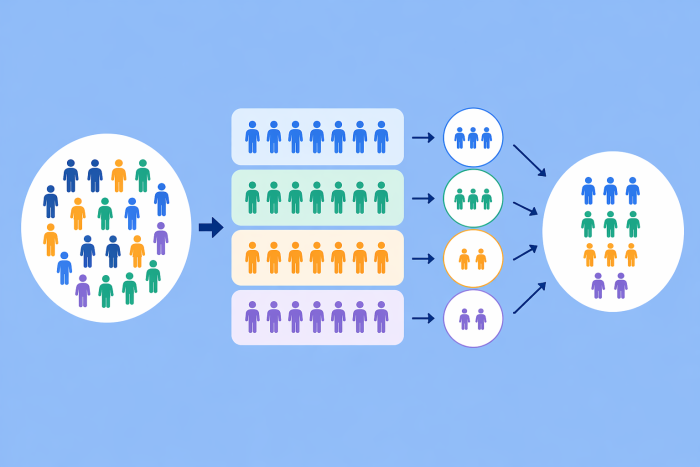
Stratified random sampling is a data collection method that involves dividing a population into smaller subgroups (called strata). These groups share similar characteristics or attributes, such as income, education level, age, race, or gender.
The final sample is made up of randomly selected members of each stratum, which is why this method is also known as proportional random sampling or quota random sampling. To analyze the survey results, researchers compare the responses of the subgroups from each stratum.
Stratified random sampling is ideal for everything from audience segmentation (for email campaigns, for example) to B2B product research to academic research. Whatever you’re working on, this guide will help you use the method effectively.
How stratified random sampling works
Think of stratified random sampling as a “divide and conquer” approach to data collection. Rather than pulling a random slice from an undifferentiated population and hoping it reflects everyone, you sort that population into meaningful groups first, and then sample from each one. The result is a composite sample with internal proportions that mirror those of the larger population.
The key word here is proportional. Let’s say you’re stratifying by gender: If women make up 52 percent of your population of interest, for example, then 52 percent of your final sample should be drawn from the female stratum. That proportionality is what makes stratified random sampling one of the most reliable data collection methods available — it builds representation into the methodology from the start rather than relying on chance to deliver it.
As Penn State teaches, “Stratification may produce a smaller error of estimation than would be produced by a simple random sample of the same size.” That’s why large research organizations, like The U.S. Census Bureau, use this method for research like the Bureau’s American Community Survey. This is also why stratified random sampling lends itself so naturally to audience segmentation work. Market analysts researching consumer behavior, public health researchers studying disease prevalence, and academics investigating demographic differences all share the same fundamental challenge: Populations are not monoliths. Stratified random sampling acknowledges that and turns it into a structural advantage.
How to perform stratified random sampling
There are a few key steps to this data collection method.
- Define your total population of interest: For example, your population of interest might be the residents of Los Angeles, or college students in the United States.
- Determine the strata for your sample: Here you might select race, gender, income level, education level, nationality, or age group. Each member of the population can only be in one stratum.
- Define the sample size for each stratum: To determine the sample size for each stratum, first divide the population of the stratum by the total population. Then multiply that number by the total sample size you need for your survey. The ratio of the sample size for each stratum to the population of the stratum should be the same as the ratio of the stratum population to the total population. That way, the responses of each group will be weighted according to the group’s size relative to the population.
Let’s say your total population size is 10,000, you need a sample size of 500 to draw conclusions, and you’re stratifying by age group. If the total population includes 2,000 people in the 18–29 age group (20 percent), your sample should include 100 respondents from this group (20 percent of 500).
- Select a random sample from each stratum or subgroup: Once you’ve determined your subgroups, randomly select participants from each stratum. You can do this by using probability sampling methods such as simple random sampling or systematic random sampling. With probability sampling, every member of the population has an equal chance of being selected.
- Review stratum results: You’ll want to verify the final sample and make sure each member of the population belongs to only one stratum and participants don’t overlap.
- Consolidate all stratum samples into one representative sample: This will ensure you have an accurate representation of the population of interest.
- Conduct the survey with the chosen subgroups: Jotform’s free online survey maker can help with this step. Choose from thousands of survey templates or type your prompt, customize questions and logic, and you’re ready to share.
When to use stratified random sampling
Stratified random sampling is a good methodology to use to gain insights into strata or subgroups within a larger population — for example, when the research seeks to explore differences among groups based on age, gender, race, education level, income, etc.
Here are a few common scenarios where stratified random sampling is the right call:
- Prevalence research across age cohorts: A medical research study could examine the prevalence of a disease in different age cohorts, with the total population of interest stratified by age brackets — such as 18–29, 30–45, 50–65, and 66-plus.
- Audience segmentation for behavior and messaging campaigns: A health insurance group seeking to design a healthy lifestyle campaign to fit the needs of its target audience could stratify subgroups by factors such as fast-food consumption, income level, whether participants exercise regularly, and so on. The data collected would then inform the most accurate healthy lifestyle messaging for each subgroup or strata to help them achieve their health goals.
- Market research for niche demographic targeting: Let’s say you own a restaurant with a reputation for being the ideal place for affluent customers in their 60s, but you want to attract more of the 30–40-something crowd who prefer more casual dining. Your subgroups could be made up of those who are 30–35, 36–40, and 41–45; the frequency at which these groups dine outside the home at restaurants like yours; and menu options they might find appealing, ranked by preference.
- Academic research with large populations: Let’s say an academic researcher wants to know how many students in a particular degree program receive a job offer after graduation. There are 100,000 graduates with a bachelor’s degree in history in 2025 — the researcher could divide that population into strata, such as age, gender, and race, and select a random sample from each stratum according to the percentage of the total population of interest that stratum represents.
- Attitudinal research across demographic segments: A researcher would like to examine opinions about religion for different age groups in the United States. Instead of gathering data from all U.S. citizens, they could collect random samples from 10,000 citizens stratified by age, like this: 18–29, 30–39, 40–49, 50–59, and 60 and above.
- User research, particularly in B2B: A B2B software company wants to better understand user behavior and usage. Their power users are most likely to respond to surveys, but surveying these users exclusively can skew the results. Instead, they could collect random samples from within strata based on usage: daily active users, monthly active users, disengaged users, etc. According to Statsig simulations, this method produced a 50 percent drop in variance across results.
Employee satisfaction across varying levels of seniority: An HR team wants to gauge employee satisfaction across a large organization. If they want to see if and how satisfaction varies based on seniority, they can stratify employees by years spent with the company: <1 year, 1–3 years, 4–6 years, 7-plus years.
When not to use stratified random sampling
Stratified random sampling is powerful, but it’s not always the right fit. It tends to fall short in situations when
- You lack reliable, consolidated data on the characteristics needed to define your subgroups.
- The population is small enough that a simpler method like simple random sampling will do the job without added complexity.
- There are no meaningful subgroup differences relevant to your research question, making stratification an unnecessary step.
- Your budget or timeline doesn’t allow for the additional classification and sampling work the method requires.
Advantages and disadvantages of stratified random sampling
To help you decide whether or not stratified sampling will work for your use case, it’s important to understand both its pros and cons.
Advantages
Stratified random sampling earns its reputation among researchers because it addresses several of the most persistent challenges in survey design at once. Since participants are randomly drawn from within each stratum, the risk of a biased sample drops considerably — you’re not leaving it to chance whether certain groups get included.
That randomness within structure also produces greater efficiency: When a population is already organized into groups that share characteristics, data collection and analysis move faster and cost less. Researchers don’t need to survey every member of a large population to draw meaningful conclusions, and the reduced scope translates directly into savings. Perhaps most importantly, when subgroup members are more similar to each other than to the total population, the data you get out tends to be more precise and proportionally accurate — characteristics of the sample genuinely reflect the makeup of the broader group.As Science Direct writes, “The randomization in this design reduces selection bias and makes the sample representative of the population as a whole.”
Disadvantages
That said, stratified random sampling comes with real trade-offs. To use it correctly, every member of the population must be identifiable and classifiable into exactly one — and only one — stratum.
In practice, that’s often harder than it sounds — people don’t always fit neatly into categories. Gathering thorough information about each subgroup and avoiding participants falling into more than one can also be time-consuming, particularly with large or complex populations. Researchers who cut corners at the classification stage may end up with overlapping strata, which undermines the accuracy of the entire sample.
Turn stratified theory into actionable data
Understanding stratified random sampling in theory is one thing. Collecting clean, well-organized data from each of your subgroups is another.
In other words: The math behind stratification can be sound, but if your data collection process is clunky — slow survey distribution, inconsistent question logic, manual result tallying — you risk falling victim to the old “garbage in, garbage out” adage, no matter how carefully you designed your strata.
That’s where Jotform comes in.
Whether you’re a market analyst running audience segmentation studies or a graduate student fielding a multi-stratum survey for a thesis, our platform is designed to handle the operational complexity so that you can stay focused on the research. Jotform’s free online survey maker gives researchers a practical way to operationalize stratified sampling without rebuilding forms from scratch for each subgroup. Start with one of over 12,000 ready-made survey templates — covering everything from academic research and consumer feedback to health assessments and demographic profiling — or use Jotform’s free AI Survey Generator to describe your research goals in a simple prompt and generate a customized survey almost instantly.
Get the right data at the right time with Jotform
Once you’ve built your forms, you can route respondents to subgroup-specific questions based on their answers with conditional logic — so a single form can serve multiple strata without creating a confusing experience for participants. That’s especially useful when you’re working with overlapping demographic variables.
On the back end, Jotform Tables organizes incoming responses automatically, so you can sort and filter submissions by stratum without manual data wrangling. When it’s time to analyze and report findings, Jotform Report Builder — along with automated reporting features — turns raw submission data into quickly digestible, shareable charts and summaries, saving you hours of work at the analysis stage. For researchers who need more advanced form options, Jotform also supports offline data collection, custom submission limits per form (useful for capping sample sizes per stratum), and integrations with tools like Google Sheets and Microsoft Excel for further analysis.
FAQs about stratified random sampling
Stratified random sampling is sometimes called “proportional random sampling” or “quota random sampling.”
Both names reflect the same core idea: that participants are selected in proportions matching their representation within the total population. The “quota” terminology is particularly common in market research, where analysts set explicit targets for how many respondents to recruit from each subgroup before closing a survey.
Among the major probability sampling methods, stratified random sampling is widely regarded as one of the most accurate, particularly when subgroups within a population differ significantly from each other. Because it guarantees proportional representation for each stratum, it reduces the sampling error that can come from accidentally over- or underrepresenting certain groups.
Simple random sampling selects a smaller group or sample from a larger group of total participants or population. This approach ensures that each participant has an equal chance of being chosen.
Researchers use simple random sampling when they want the data they collect to be representative of the total population of interest. It’s also a good method for when researchers must choose samples quickly, such as with time-sensitive opinion polls and market research.
Systematic sampling is a probability sampling method in which members are chosen from a larger population based on a random starting point and selected at a fixed, regular interval. One example would be choosing every 10th person on a list of all members of the population. The interval is determined by dividing the population size by the desired sample size.
Researchers may use systematic sampling when they have a restricted budget and need a simpler process.
With cluster sampling, researchers divide a larger population into groups (known as clusters), such as by cities, schools, or geographic location. Researchers then randomly select among the clusters to create a sample. As opposed to stratified random sampling, you randomly select entire groups and include all units of each group in the relevant sample.
By its nature, cluster sampling is more affordable to carry out, while stratified random sampling is more accurate and precise.
The most reliable way to minimize bias is to ensure that every member of your population of interest has a known, non-zero chance of being selected.
In stratified random sampling, this means carefully defining your strata so there’s no ambiguity about which group a person belongs exclusively to, and then using genuinely random selection methods within each stratum.
Avoid allowing self-selection, where participants volunteer, as this tends to skew results toward people with particularly strong opinions or motivations.



































Send Comment: