
7 alternatives to Outgrow
You’re here because you want data — specifically, marketing data. Maybe you’re a B2B marketer, a demand gen manager, or a small business owner trying to capture more qualified leads. If so, you know tools like Outgrow can be a game-changer. Interactive calculators, online quizzes, and chatbots don’t just collect emails; they qualify prospects before they ever talk to sales.
Outgrow is popular for good reason. It combines calculators, assessments, quizzes, and chatbots into a single no-code platform, with strong CRM integrations and analytics that show exactly where users drop off in your funnel.
But as campaigns scale, the platform’s limitations become harder to ignore. Lower-tier plans cap leads and content pieces, while white labeling is locked behind the $600/month Business plan. For growing teams, those constraints are often the tipping point.
If you want Outgrow’s interactive marketing capabilities without the trade-offs, keep reading. We cover seven alternatives, including where each platform stands out and where it falls short.
 Jotform |  Typeform |  involve.me |  Calconic |  Riddle |  LeadQuizzes |  Ion Interactive | |
|---|---|---|---|---|---|---|---|
| Best for | All-around lead gen with strong data backend | Polished, high-completion conversational forms | Multi-step funnel builders who want Outgrow-style logic | Teams that only need an embedded calculator | Publishers and media brands producing interactive content at scale | Quiz-driven lead gen on a lean budget | Enterprise demand gen and ABM teams |
| Content types | Forms, quizzes, calculators, chatbots, surveys | Forms, quizzes, surveys | Quizzes, forms, calculators, outcome pages, payment flows | Calculators only | Quizzes, polls, personality tests, leaderboards, surveys, mini-games | Quizzes, assessments, surveys, forms, calculators | Quizzes, assessments, calculators, infographics, white papers, landing pages, solution finders |
| Starting price | Free; paid from $34/mo | Free; paid from $28/mo | Free; paid from $19/mo | Free; paid from $5/mo | $119/mo | $9/mo | Custom (contact sales) |
| Lead capture | Basic (email gate on results) | ||||||
| Calculator builder | Yes (Form Calculation Widget) | Yes (dedicated) | Yes (via variables, not a dedicated interface) | Basic | |||
| Logic & branching | Yes (advanced) | Conditional logic | Yes (advanced) | ||||
| White-label option | Yes (all paid plans) | Yes (Plus plan, $50/mo+) | Yes (Pro plan, $59/mo+) | Yes (paid plans) | Yes (standard paid plans) | Yes (all paid plans) | |
| CRM integrations | 250+ (Salesforce, HubSpot, Zendesk, Mailchimp, and more) | HubSpot, Salesforce, Mailchimp, Zapier | HubSpot, Salesforce, ActiveCampaign, Klaviyo, Zapier, Make | Zapier only | 7,500+ via API, webhook, Zapier | HubSpot, Salesforce, Mailchimp, ActiveCampaign, Zapier | Marketo, Salesforce, HubSpot, Eloqua, Demandbase |
| Ease of use | High | Very high | Medium | Very high | High | High | Low (significant learning curve) |
| Analytics & reporting | Yes (Tables + Report Builder) | Basic (advanced on higher tiers) | Yes (built-in funnel analytics) | Basic | Basic (advanced on Business tier) | Yes | Yes (A/B testing, full analytics) |
1. Jotform
The case for Jotform isn’t just pricing; it’s that most teams rarely outgrow it. What started as a form builder has evolved into an interactive lead-generation platform with quizzes, AI chatbots, and white labeling on even the lowest-paid plans.
Jotform’s Form Calculation Widget gives teams granular control over math-heavy tools such as ROI calculators, pricing estimators, and health trackers, with formula depth comparable to Outgrow’s at a fraction of the cost.
On the quiz and chatbot side, the Jotform AI Quiz Generator accepts a plain-text prompt or document upload (PDF, PowerPoint, Word, or image files) and returns a ready-to-edit quiz in seconds. Teams can regenerate questions, adjust difficulty, switch languages, and customize the design all within the same builder. The AI Chatbot Builder handles the other side of the interaction, guiding prospects through forms in real time to reduce abandonment.
Backend data management is another area where Jotform stands out. Submissions automatically flow into Jotform Tables for real-time tracking, while the Report Builder makes it easy to optimize your lead generation process without CSV exports or separate BI tools.
Teams can start from one of Jotform’s 20,000+ templates, including a quiz template library and a deployable Quiz App template for faster launches.
Why people switch to Jotform
- The AI tooling is more mature than most competitors. Jotform AI shifts the experience from traditional drag-and-drop building to a conversational workflow in which users describe what they need, and the platform automatically generates the structure, logic, and layout.
- The pricing floor is genuinely low. Most of what Outgrow gates behind mid-tier plans (custom branding, deeper logic, calculator tools) is accessible in Jotform’s Bronze tier at $34/month.
Limitations of Jotform
- The free plan is tighter than it looks. The Starter plan caps at 5 forms, 100 monthly submissions, 1,000 monthly form views, and 100 MB storage, with Jotform branding on every form.
- It’s not a dedicated interactive content platform. Jotform’s quiz and calculator features are powerful, but they’re layered on top of the form builder rather than built into it.
2. Typeform

Typeform built its reputation on creating forms people actually want to complete. Its one-question-at-a-time conversational interface often outperforms traditional forms on engagement, with many teams reporting significantly higher completion rates than standard form builders.
For B2B marketers running lead-generation flows, product recommendation quizzes, or brand surveys where user experience directly impacts conversion rates, that difference can matter.
The platform covers the core interactive content use cases, including logic jumps, score-based outcomes, and native integrations with HubSpot, Mailchimp, Salesforce, and Zapier. Forms are mobile optimized and fully brandable on paid plans, making Typeform a strong fit for teams that treat forms as part of their overall brand experience.
Why people switch to Typeform
- The conversational format genuinely reduces friction. Breaking forms into single-question steps can make longer lead-gen flows feel less overwhelming, which often translates into higher completion rates and more captured leads.
- The integration ecosystem is also mature. Native connections with HubSpot, Salesforce, Mailchimp, and Zapier help teams move data into existing workflows without relying heavily on custom automations.
Limitations of Typeform
- The response limits hit fast. The Basic plan at $28/month includes only 100 responses. A weekly newsletter sign-up form can hit that ceiling within days.
- Native integrations have notable gaps for email-heavy teams. Typeform connects directly to HubSpot, Salesforce, Mailchimp, and Zapier, but lacks native integrations with several common email marketing platforms, including Kit, Flodesk, AWeber, GoHighLevel, and MailerLite.
3. involve.me
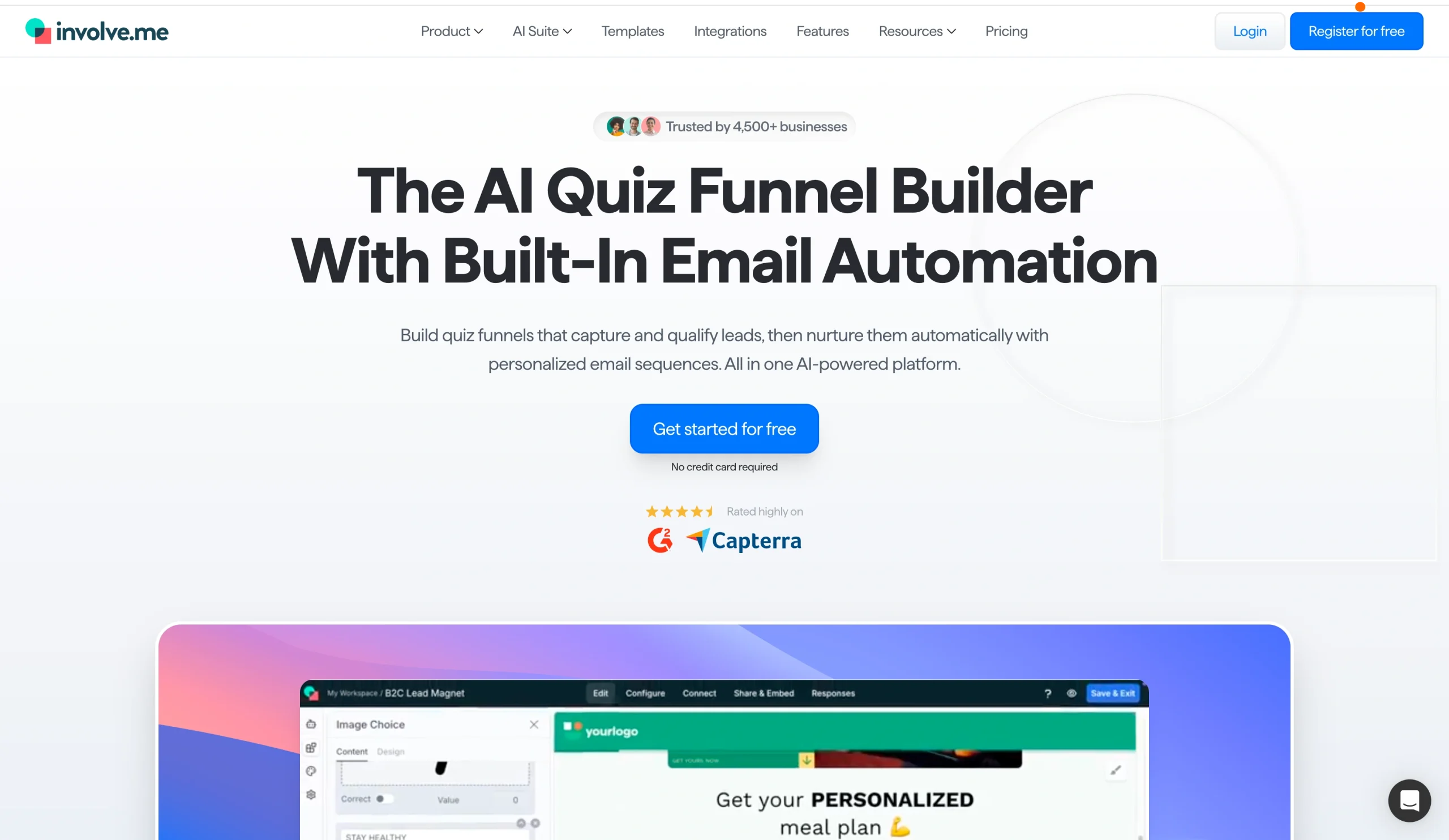
Where Typeform focuses on polished forms and Jotform emphasizes breadth, involve.me focuses on funnel building. It’s one of the closest experiences to Outgrow on this list, combining quizzes, forms, calculators, and personalized outcome pages into a single multi-step workflow.
Conditional logic, answer piping, and logic jumps adapt each step in real time based on user responses. Leads can be scored automatically as they move through the funnel, helping sales teams receive more qualified prospects instead of raw submissions.
The platform’s AI Agent, launched in 2025, lets users describe what they want in plain English and automatically generates the funnel structure, pulling in brand colors and logos. For teams that want Outgrow-style interactive content without spending hours configuring logic, this can be a meaningful time-saver.
Native integrations include HubSpot, Salesforce, Mailchimp, and Google Sheets, while Zapier and Make extend support to additional apps. Paid plans start at $19/month (billed annually), positioning involve.me between lightweight form builders and larger marketing automation platforms.
Why people switch to involve.me
- It replicates Outgrow’s funnel logic at a lower entry point. Quizzes that score leads, calculators that generate custom quotes, and multi-step flows that segment visitors are all available in the Starter tier.
- The AI funnel builder accelerates setup meaningfully. Rather than configuring logic step by step, you describe the funnel goal, and the AI builds the structure.
Limitations of involve.me
- Key features are gated behind higher tiers. Branding removal requires the $59/month Pro plan, and A/B testing, custom CSS, and webhooks are locked behind the $129/month Business tier.
- The free plan is nearly unusable for real campaigns. It caps at 50 submissions per month, retains data for only 30 days, and includes no integrations or logic jumps. The 14-day paid trial requires billing details upfront and auto-charges if not canceled; the platform generally does not offer refunds once billing begins.
4. Calconic
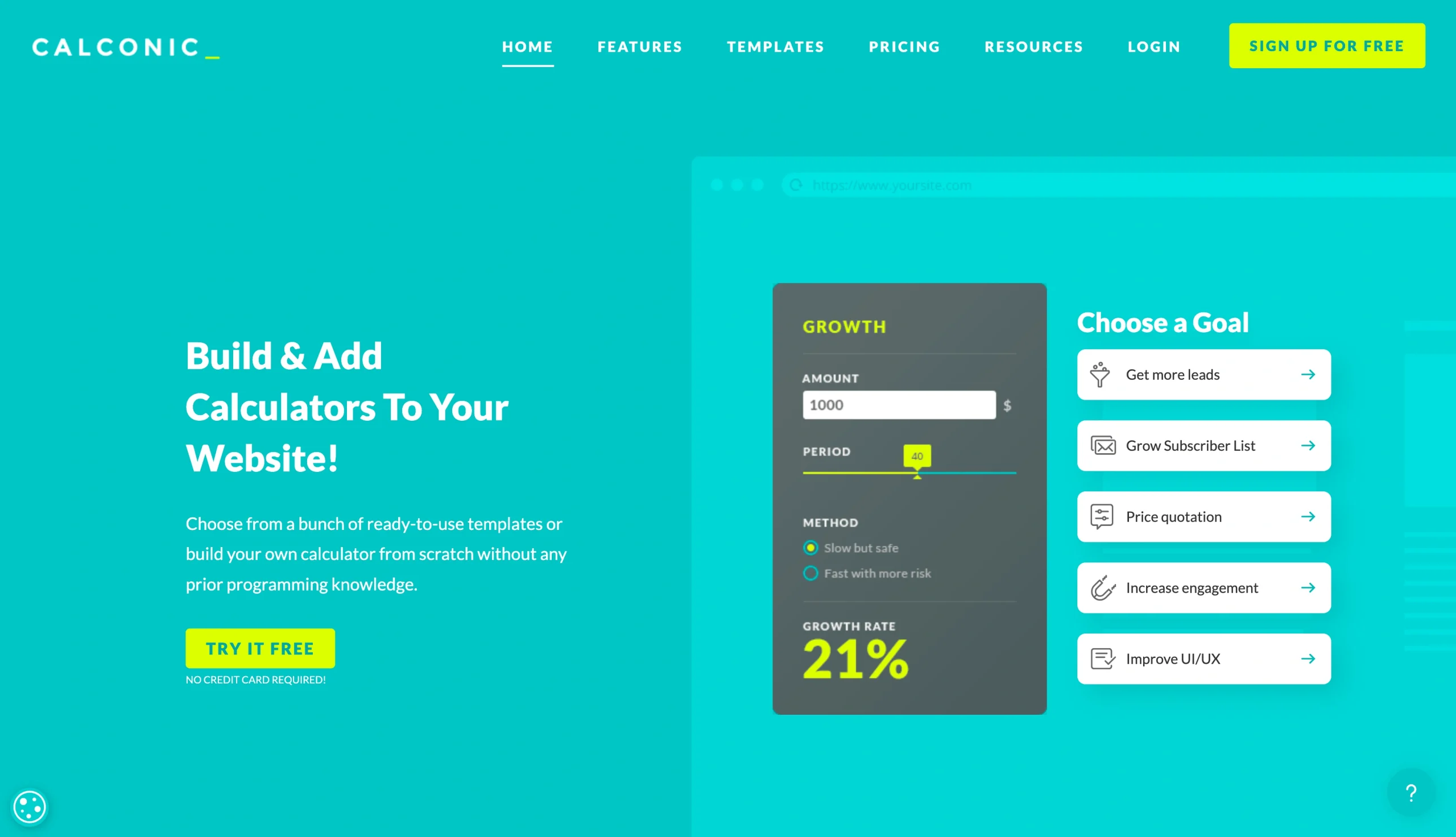
Not every team needs quizzes, chatbots, and assessments. Some just need a calculator that works. Calconic is a dedicated calculator builder for pricing estimators, ROI calculators, quote generators, and cost tools, without the broader interactive-content overhead that platforms like Outgrow bundle in — and charge for.
The drag-and-drop editor uses a clean grid-based layout with snapping support, while style controls cover fonts, colors, and sizing across desktop, tablet, and mobile views. The formula editor handles everything from straightforward price quotes to more advanced conditional calculations, and the platform does not publicly document limits on fields or formulas.
Calculators can be embedded via JavaScript or iFrame and work with platforms like Squarespace, Wix, and WordPress. Paid plans also support payment collection through Stripe and PayPal, making Calconic a viable option for service businesses that want to move users from quote to checkout in a single flow.
Paid plans start at $5/month (billed quarterly), and all paid tiers remove Calconic branding. A 14-day free trial includes access to the full feature set.
Why people switch to Calconic
- It’s the lowest-cost entry point for a serious calculator. At $5/month, teams that only need an embedded pricing or ROI calculator aren’t forced to pay for quiz builders, chatbot tools, or lead scoring systems they’ll never use.
- The visual editor is genuinely fast to work with. Multiple reviewers report building functional, on-brand calculators in under 15 minutes without prior experience.
Limitations of Calconic
- The impression-based billing model has a known flaw. Some find that the impression counter depletes even with no active traffic, effectively burning through limits faster than actual usage warrants.
- It’s a calculator builder, not a lead generation platform. Calconic has no native quiz builder, chatbot, lead scoring, or multi-step funnel logic. If your use case expands beyond pricing calculators, you’ll need a different tool.
5. Riddle
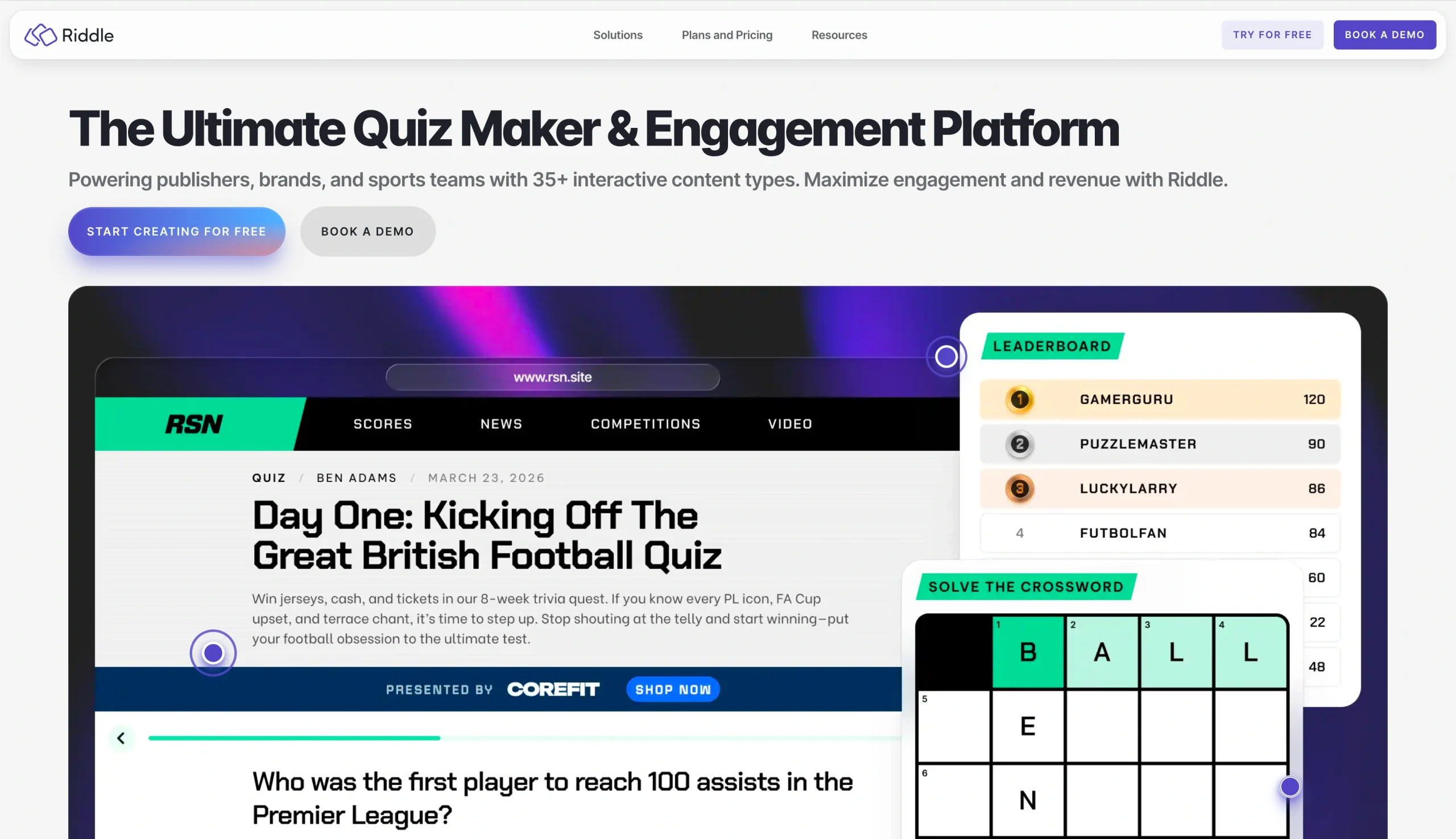
Riddle is built for teams that publish interactive content continuously, not just for occasional lead-generation campaigns. While many tools on this list focus on single conversion funnels, Riddle is geared toward publishers, sports organizations, media brands, and enterprise marketing teams that need a steady stream of quizzes, personality tests, leaderboards, and surveys across high-traffic sites.
The platform includes more than 34 interactive content block types that can be combined into a single experience, while its integration layer connects with thousands of tools through APIs, webhooks, and Zapier.
White-label functionality is also more accessible than with many competitors. Custom fonts, CSS controls, and removal of third-party branding are available on standard paid plans instead of being restricted to enterprise tiers. Pricing starts at $119/month and includes unlimited content, views, and leads.
Why people switch to Riddle
- White-label is included at the base level. Riddle offers white-label customization on its standard paid plans, starting at $119/month.
- The content format range goes deeper than most quiz builders. Beyond standard quizzes, Riddle covers personality tests, predictions, ranked lists, leaderboards, and mini-games.
Limitations of Riddle
- It’s not optimized for lead-gen funnels. Riddle excels at engagement and zero-party data collection, but it lacks the multi-step funnel logic, lead scoring, and payment collection that tools like involve.me offer.
- Advanced customization requires higher-tier plans. Custom CSS, advanced tracking via Google Tag Manager, and API access for automating content workflows are gated behind the Business tier.
6. LeadQuizzes
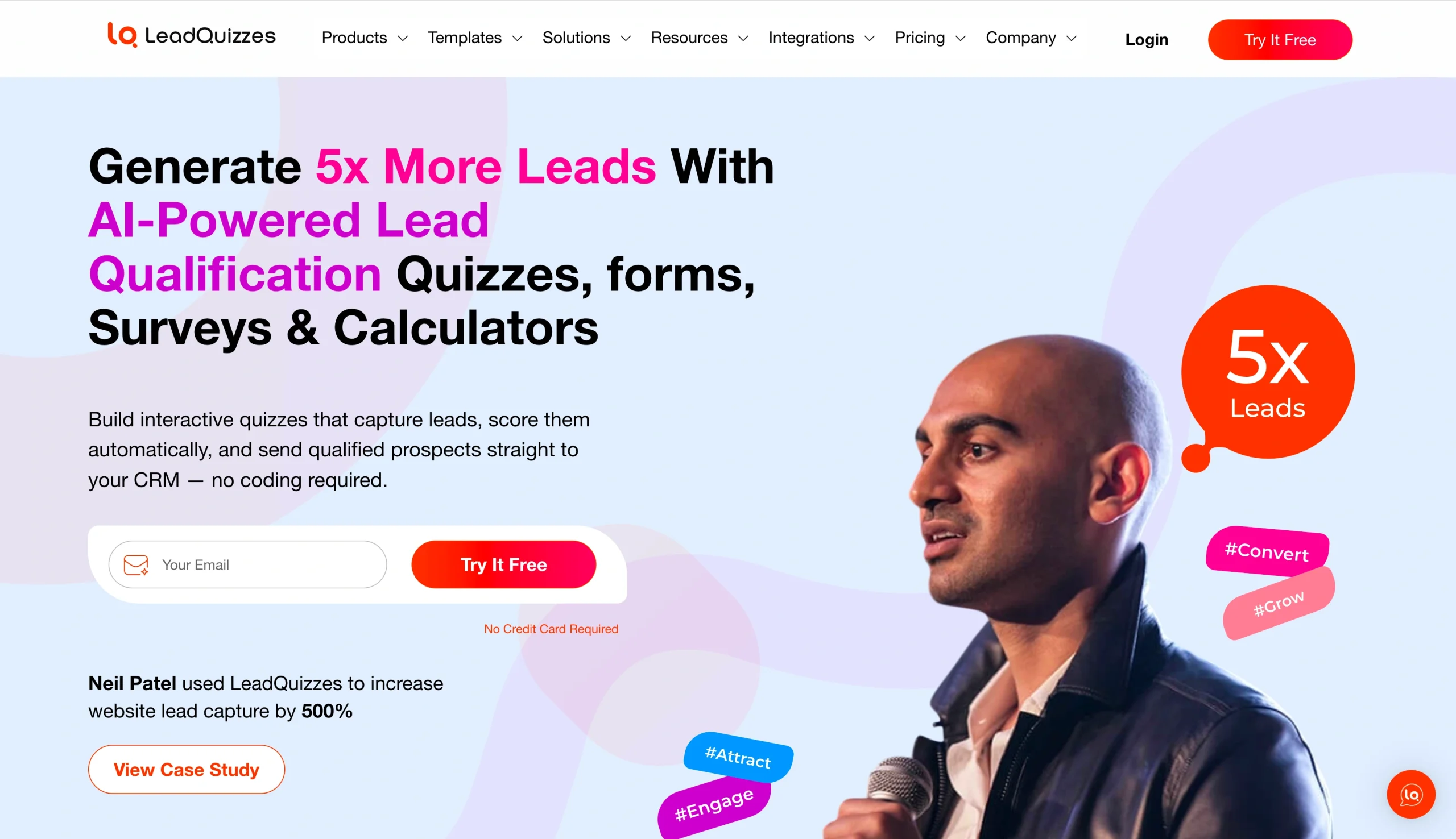
LeadQuizzes is built to turn quiz and assessment responses into qualified leads. Unlike broader interactive-content platforms, it specializes in lead-generation workflows rather than expanding into chatbots, publishing tools, or all-purpose form building.
The drag-and-drop builder supports personality quizzes, diagnostic assessments, calculators, and forms, with branching logic and skip paths that adapt the experience based on user responses. Different answer paths can automatically route respondents to personalized result pages, lead-capture forms, or disqualification screens.
The AI Quiz Builder generates quiz funnels from a prompt, and built-in scoring and outcome logic automatically segment leads. Native integrations include HubSpot, Mailchimp, ActiveCampaign, Salesforce, and thousands of additional apps through Zapier. Paid plans start at $9/month (billed annually) and include a 14-day free trial.
Why people switch to LeadQuizzes
- The setup-to-launch time is short. The interface is focused enough that teams without technical backgrounds can build a functional, branching quiz funnel in under an hour.
- The entry price is low relative to what it delivers. At $9/month, the Startup plan includes the AI quiz builder, lead scoring, conditional logic, integrations, and 75+ templates.
Limitations of LeadQuizzes
- No API and limited design flexibility. LeadQuizzes does not offer an API, which rules it out for teams that need programmatic integration or custom data workflows. Design customization is also constrained — users flag a lack of control over visual styling beyond basic brand colors and logos.
- Customer support has a documented reliability problem. Billing disputes, slow response times, and auto-renewal complaints are reported on different review sites.
7. Ion Interactive (by Rock Content)
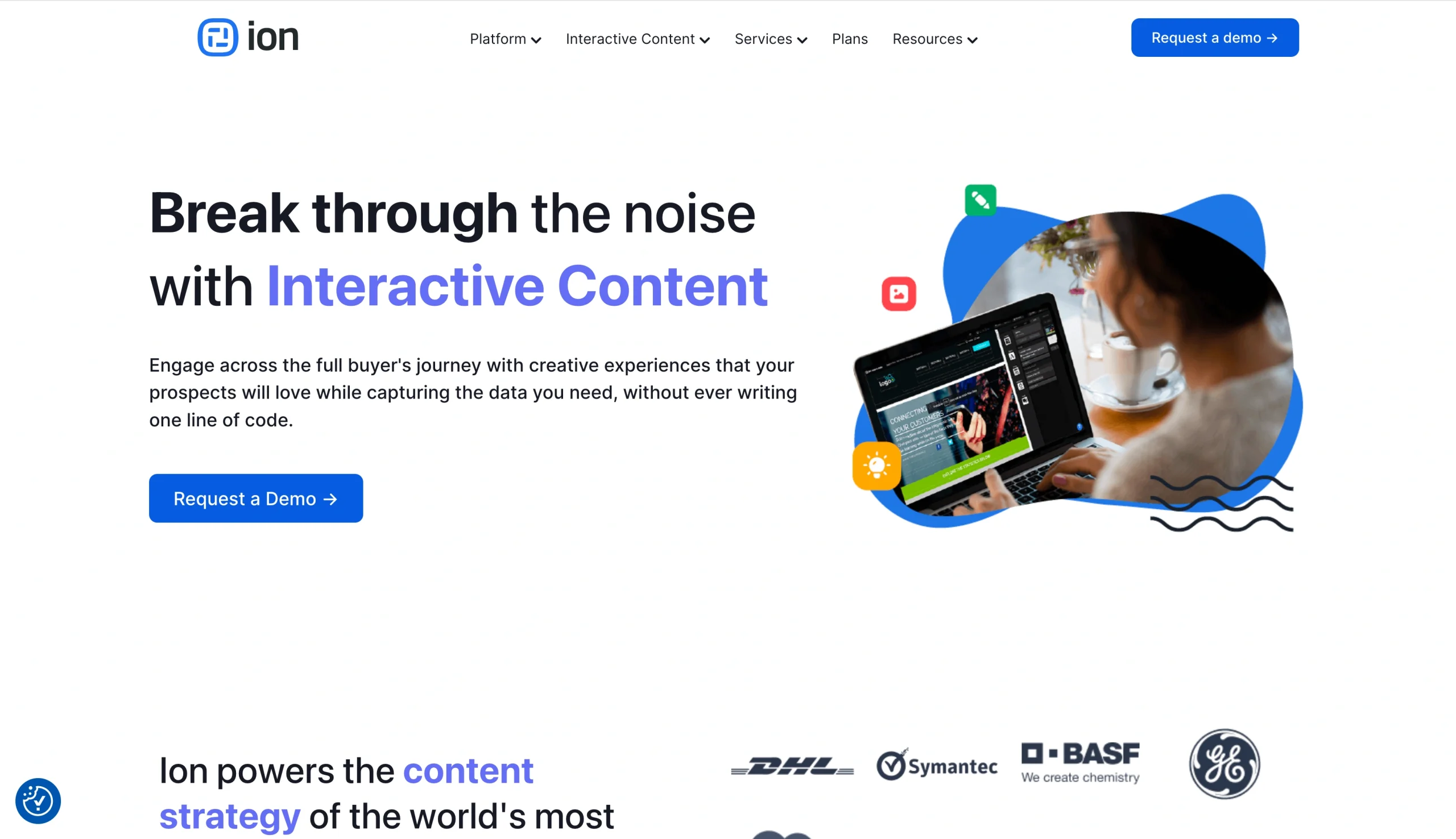
Ion Interactive by Rock Content is the enterprise-focused option on this list. The platform supports assessments, calculators, eBooks, interactive infographics, white papers, landing pages, lookbooks, quizzes, resource libraries, and solution finders within a no-code drag-and-drop environment backed by more than 100 Quick Start templates.
Ion is designed for mid-market and enterprise marketing teams running demand generation, sales enablement, and account-based marketing programs at scale — not businesses looking for a lightweight quiz or calculator tool.
The platform integrates with Marketo, Salesforce, HubSpot, and Demandbase, and sits within the broader Rock Content ecosystem alongside WriterAccess and Studio. For teams already using Rock Content for content operations, Ion adds interactive experiences without requiring another vendor relationship. Pricing is custom and requires a sales conversation.
Why people switch to Ion Interactive
- It covers the full spectrum of content formats on a single platform. Teams that need interactive infographics, white papers, solution finders, quizzes, and calculators don’t have to stitch together multiple tools.
- The CRM and marketing automation integrations run deep. Ion’s targeting options let teams segment content based on location, interests, device, time of day, and past behavior, and the data flows directly into enterprise MAP and CRM systems.
Limitations of Ion Interactive
- The learning curve is real and well-documented. The platform’s power lies in its interactivity engine rather than its visual editor, and users note that it takes significant time and patience to learn.
- The price point and opaque pricing model exclude most small teams. Ion is explicitly marketed at enterprise clients, and pricing requires a sales conversation.
Turn lead data into something actionable with Jotform
The promise of a tool like Outgrow isn’t just about building interactive content. It’s what you do with the responses after.
Most teams spend more time wrangling lead data than they’d like to admit — waiting on exports, formatting spreadsheets, pulling together reports for stakeholders who needed them yesterday. Jotform Tables eliminates that bottleneck. Every submission lands in a live, structured view the moment it comes in. No manual exports, no syncing required. Your team sees the data as it happens.
From there, the Report Builder turns those responses into shareable visual reports without a separate analytics tool or BI platform. Build the report once, share a link, and stakeholders stay up to date automatically.
What makes Jotform punch above its price point is the integration ecosystem that supports it all. With 250+ form integrations (including CRM tools like Salesforce, HubSpot, and Zendesk, plus Google Drive, Slack, Mailchimp, and Canva), lead data flows to the right stakeholders. That’s more native connections than Outgrow offers at any plan tier.
If you’re looking for the lead-capture, data-tracking, and reporting capabilities of a premium interactive content platform without the premium price tag, Jotform’s free trial is worth a test.
This article is for B2B marketers, demand generation managers, and SaaS growth teams who are hitting Outgrow’s pricing ceiling, lead caps, or content piece limits — and small-to-mid-sized businesses that need a more affordable or flexible way to build calculators, quizzes, assessments, and interactive funnels without committing to Outgrow’s higher tiers.























Send Comment: