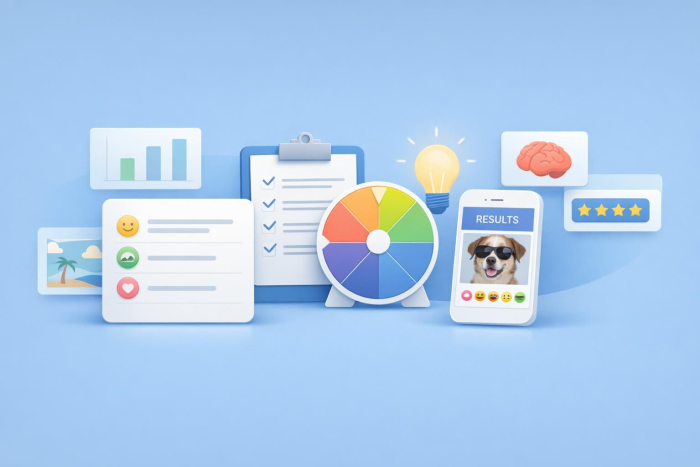
Which sounds more like you?
- Morning person or night owl?
- Someone who plans their travel on a spreadsheet or someone who decides everything at the airport?
For each question, you probably picked one, and that small pull is what personality quizzes are built on. They pull people in before anyone’s decided whether they care about the results. That instinct cuts across audience types. It’s why millions of people have taken BuzzFeed’s “Which Disney character are you?” quizzes, and Fortune 500 companies still pay for Myers-Briggs assessments to help them understand their teams.
Whether you want to know how to make a BuzzFeed-style quiz for engagement or a lead generation tool for your business, the mechanics are the same. This article walks you through how to make a personality quiz online, no coding or design experience required.
What is a personality quiz?
A personality quiz is a series of questions designed to reveal something about the person taking it. There are no right or wrong answers. Each response maps to one of several outcome types, and the best-fitting type becomes the result. Brands use personality quizzes to engage their audience, generate leads, and gather data for personalizing communications with customers. For example, Tonic Site Shop’s Brand Cocktail Quiz matches entrepreneurs with a Showit website template (each named after a well-known cocktail) that fits their branding, helping them choose a design they’ll love.
4 types of personality quizzes
Personality quizzes come in different formats, and the right one depends on what you want the quiz to enable: social engagements, product recommendations, or lead captures. Each of the following formats has a specific goal, and settling on the right type will shape the questions you ask and the result pages you design:
- Character and archetype quizzes: These quizzes sort takers into named identities, such as a fictional character, a branded persona, or a custom archetype. They work best for entertainment, social sharing, and brand engagement, with the result being something takers will want to post. For instance, “Which Hogwarts house are you?”
- Style and preference quizzes: These quizzes match the taker to an aesthetic, a taste, or a set of preferences rather than to a personality archetype. They’re commonly used in e-commerce and marketing, where the results connect to something the brand can recommend next, such as a skin care routine or an interior design style.
- Assessment and type quizzes: These quizzes draw on established personality frameworks such as Myers-Briggs, the Big Five, Enneagram, and learning styles to sort takers into well-recognized categories. These quizzes are good for self-reflection, career development, and training.
- Lead generation quizzes: These can take the form of a character quiz, preference quiz, or assessment quiz, with an email address field added before the result. Lead generation quizzes are mostly used in B2B marketing and online businesses. The taker exchanges their email address for a personalized result, and the brand gets a qualified lead in return.
How to make a personality quiz in 4 steps
Once you’ve figured out the type of personality quiz you need, building one comes down to four easy steps, none of which requires code. All you need is some creativity and the Jotform Personality Quiz Maker.
Building a personality quiz? Jotform AI makes it easy.
- Write a prompt: No coding, no templates, no hassle. Just tell Jotform AI what kind of quiz you want to create.
- Customize your quiz: Use AI to design your quiz. Ask Jotform AI to change colors, add form fields, edit text, and add conditional logic.
- Review and share: Satisfied with your quiz? Share or embed it to collect responses.
Jotform AI is the perfect partner for building great-looking quizzes with zero stress. It even makes helpful suggestions along the way, so you’ll always have a reliable copilot by your side.
1. Define your result type
Many people make the mistake of writing questions first. But the questions in your personality quiz make sense only when you know which results or personality types they’re sorting people toward. So start by defining the outcomes participants can be assigned to based on what you want the quiz to accomplish and whom you’re building it for.
If you’re building a self-reflection or career development quiz, you can borrow familiar personality frameworks such as the Myers-Briggs Type Indicator or the Big Five traits. Alternatively, you can use branded archetypes that sort takers into custom types tailored to your brand’s audience and voice, delivering results that aren’t replicable anywhere else. For example, Beardbrand, a men’s grooming brand, sorts takers into types based on grooming style and aesthetics.
For e-commerce or lead generation quizzes, the result types can double as product recommendations. For instance, a skin care quiz might sort takers into a “sensitive routine” or “oil-control routine” that maps to specific products. For an entertainment brand or a social engagement quiz, pop culture results modeled after characters from popular shows work well; the audience is already familiar with the outcomes and the results land without needing much explanation.
As you define your result types, keep the numbers manageable. Most online quizzes work best with three to six result types because it will keep the results balanced and clearly distinguished from one another. Each result should include a clear identity: name, short description, and traits that don’t overlap with the other results.
2. Write questions that feel like a conversation, not a form
The questions in your quiz determine whether someone finishes or drops off partway through. Because questions are the part of the quiz participants actually experience, they should feel personal, spark a connection, and make takers curious enough to reach the results.
A good rule of thumb is to write questions that ask about the person through scenarios, preferences, or gut reactions. The reason is simple: People who take personality quizzes are looking for answers that best represent them.
Here are some examples of good personality quiz questions to help spark ideas.
- Self-reflection quiz
- If you were stranded in a foreign city for a day with no plans, would you … ?
- When making a big decision, do you trust your gut or weigh every possible outcome?
- Pick the weekend that sounds most like you.
- Branded archetype quiz (e.g., coffee brand)
- What’s your weekday morning order?
- If you owned a cafe, which detail would you obsess over most?
- What’s your perfect coffee shop scene?
- Product recommendation quiz (e.g., skin care)
- How does your skin usually feel by midday?
- When you try a new product, do you give it a full month to work or move on after a few days if you don’t see results?
- Which sounds most like your current routine?
- Pop culture character quiz
- Your friends throw you a surprise birthday party; what’s your first reaction?
- If your life had a soundtrack, what genre would it be?
- Your go-to comfort watch: sitcom, true crime, or cooking competition?
- Career development quiz
- When learning a new skill, do you research it thoroughly first or jump in and figure it out as you go?
- Which kind of feedback motivates you more?
- Your move under a tight deadline: plan it out, dive in, or delegate?
Six to 10 questions usually are enough to sort takers accurately into answer types without making the quiz feel long. Presenting one question at a time helps too, because a full page of question fields can look like paperwork. Jotform Cards displays each question on its own screen, making the quiz feel more like a conversation than a survey. Where it suits the question, letting people select an image instead of reading through text answers makes the experience more engaging.
3. Map answers to result types
After writing questions, the next step is to map each answer to a specific result type. Without mapping answers to predefined personality types, all you have is a simple survey that doesn’t drive the desired result. Plus, answer-mapping is where personality quiz accuracy lives; if the mapping is off, takers end up with results that don’t fit, so they won’t share them.
You can map answers to outcomes using any of the following:
- Points-based system: Each answer is tied to one result type and awarded a single point. This is the cleanest approach, so at the end of the quiz, the result with the highest total points is displayed.
- Weighted scoring: Some answers award more points than others to signal stronger preferences.
- Multi-type scoring: A single answer awards points to two or more result types. This is useful when your result types share overlapping traits.
You don’t need complex formulas or a spreadsheet to set up any of this. In a no-code personality quiz generator such as Jotform, conditional logic handles the scoring once you connect each answer to a results type.
4. Design your result pages
The results page is what people screenshot and share, which makes it as important as the questions that lead to it. Give each result type its own page with a name, a short description of what makes the personality type distinct, and an image that represents it. Keep the description tight, two or three sentences, and aim for flattering but honest. If you’ve collected the participant’s name during the quiz, personalize the page by including it.
As you design the results page, make sure it renders well on mobile because most takers will see and share results on phones. Also, consider matching the colors and fonts to your brand so that when someone shares a screenshot of their results, your branding travels with it.
Beyond the result itself, the page should drive whatever you want to happen next: a share button if your goal is social reach, an email address field if you’re collecting leads, or a product recommendation if the quiz is guiding a purchase.
5 best practices for making a personality quiz
Now you know how to create a personality quiz. Here are some best practices that shape whether participants complete your quiz, trust the result, and share it:
- Name your result types memorably: The names you give your result types are what takers remember and share. Avoid generic labels such as “Type A.” Instead, aim for names that are specific, evocative, and tied to your quiz’s theme.
- Keep it to 10 questions or fewer: According to Outgrow, short quizzes of three to seven questions have the highest completion rates at 65 to 85 percent. To maximize engagement, stick to 10 questions or fewer.
- Make every answer feel valid: Every option should feel like a choice a person might make in the situation. If one option clearly looks better than the others, takers will pick it rather than answering honestly, skewing the results.
- Write result descriptions that are 80 percent strength, 20 percent growth areas: People share results they are proud of, but results that flatter too obviously feel fake. An 80/20 ratio of mostly strength and one honest growth area keeps the result aspirational and credible.
- Add a share button to the results page: A one-click share button covering social media, email, or the option to copy the link encourages people to share their results.
14 personality quiz ideas to get you started
If you’re looking for inspiration for your next personality quiz, here are 14 quiz ideas organized into four categories. Each is a starting point you can shape to your audience, brand, or content goal.
For fun and social sharing
- What type of traveler are you? Sort takers into travel personality types such as budget backpacker, comfort-first planner, spontaneous wanderer, or culture seeker based on how they approach trips.
- Which decade were you born in? Match the participants to an era such as the 1920s, ’60s, ’80s, or ’90s based on their style, values, and pop culture preferences.
- What’s your communication superpower? Identify the taker’s strongest communication style, such as listening, motivating, mediating, or storytelling.
- What kind of friend are you? Place participants into friend archetypes such as the loyal one, the planner, the ride-or-die, or the honest one, based on how they show up for the people in their lives.
For e-commerce and product recommendation
- What’s your ideal skin care regimen? Map the participant’s skin concerns, habits, and goals to a recommended product set or routine.
- Find your perfect workout style. Sort takers into a workout type such as high-intensity, strength-focused, low-impact, or group fitness, and point them toward matching programs or gear.
- Which coffee drink matches your personality? Pair takers with a coffee order (espresso, cold brew, latte, flat white) based on personality, doubling as a brand-friendly recommendation.
For content marketing and lead generation
- What’s your marketing personality type? Identify the participant’s natural marketing style, such as analytical, creative, brand-driven, or growth-focused. This is useful for marketing tools and agency lead funnels.
- Which leader are you? Sort participants into leadership archetypes such as the servant leader, visionary, operator, or coach.
- What’s your team role? Reveal what the taker brings to a team, such as driver, organizer, creative, or mediator, based on how they collaborate.
- What kind of entrepreneur are you? Map the taker to an entrepreneur archetype, whether visionary founder, operator, hustler, or steady builder.
For education and training
- What’s your learning style? Identify whether the taker learns best through visuals, audio, hands-on practice, or reading and writing.
- Which career path suits you? Sort participants toward broad career types or specific roles based on interests, skills, and work preferences.
- What type of problem solver are you? Reveal the taker’s problem-solving approach, such as analytical, creative, systematic, or intuitive.
Make your own personality quiz with Jotform in minutes
Jotform’s Free Personality Quiz Maker brings everything we’ve written about here into a user-friendly no-code tool. Whether you’re building a fun quiz for social reach or a lead generation quiz for your business, Jotform covers the full workflow: writing questions, designing results pages, mapping results, capturing leads, and analyzing responses.
Using Jotform’s online personality quiz builder is easy. Instead of starting from scratch, you can choose from 1,500-plus free quiz templates across trivia, assessments, surveys, and personality quizzes, then customize them for your audience. The quiz builder is fully drag-and-drop, with no coding required. You can add or remove questions, change answer types, embed images and videos, and adjust the form layout without needing any design experience. Jotform AI can also help you make changes and customize your quiz through dynamic conversations in the form builder. Once you’ve set up your questions, answers, and outcome types, Jotform’s conditional logic automatically calculates point totals and handles the scoring without formulas or spreadsheets. This way, participants land on the right results page based on their answers.
As you design the results page for each personality type, Jotform lets you match the design to your brand and add thank-you screens or external redirect links upon submission. If you’re running the quiz for lead generation, you can connect to 100-plus tools, including Mailchimp, ActiveCampaign, HubSpot, Constant Contact, and Salesforce, so email addresses captured during the quiz flow directly into your email marketing tool or CRM.
For a more immersive experience, Jotform’s Personality Quiz AI Agent turns the quiz into a conversational form. Instead of clicking through static questions, takers can chat with an AI agent that asks personality questions and delivers personalized insights.
Once the quiz is live, Jotform’s Report Builder turns responses into visual reports so you can easily see which result types come up most often and where your audience clusters. Marketers and creators tracking audience segments can use this data to shape future content, campaigns, or product decisions.
If you’re ready to make a personality quiz online and start engaging your audience or generating leads, try Jotform’s free quiz maker today, with no coding or credit card required.
This article is for individuals, content creators, educators, and marketers who want to build an engaging personality quiz — whether for fun, audience engagement, social sharing, or lead generation.


















Send Comment: