
If you’re in marketing for a healthcare organization, you already know how much effort goes into getting a patient to click “Book an appointment.”
You build the campaigns.
You optimize the landing pages.
You refine messaging, test CTAs, and track conversions.
And then, something unexpected happens.
They drop off. Not on the ad or the landing page, but right after they start to book an appointment.
The moment you’re not measuring is the one that matters most
Here’s the uncomfortable truth: For many healthcare organizations, the biggest conversion gap isn’t in marketing. It’s in the intake process.
Patients today don’t just compare your intake experience to other medical practices. They compare it to everything from banking apps to travel booking to retail checkouts. Fast, intuitive, mobile-first experiences are the baseline.
So when a patient clicks to schedule and is immediately met with a long, clunky, confusing intake form, it creates friction you can’t see in your campaign dashboard. And that friction costs you patients.
Intake is no longer an admin step: It’s part of your funnel
Traditionally, intake has been treated as a back-office function. But that’s not how patients experience it.
From their perspective, intake is part of the journey. It’s the first real interaction they have with your practice after showing intent.
That’s why leading healthcare marketing teams are starting to treat intake differently, not as paperwork, but as a conversion moment.
Because that’s exactly what it is.
The hidden funnel: Where patients actually drop off
Think about your current funnel.
You likely have visibility into
- Ad performance
- Landing page conversions
- Appointment requests
But what happens after someone clicks to book? In many cases, that’s where the experience breaks down.
Patients are asked to
- Fill out long forms with no clear structure
- Provide extensive information up front without context
- Navigate experiences that aren’t built for mobile
- Complete a process without knowing how long it will take
And worst of all, sometimes they don’t even get a clear confirmation of their appointment or the next step in the intake process. So they leave.
This “digital front door” of your practice is one of the most important (and overlooked) moments in the entire patient journey.
Why this matters more than ever
Patient expectations have changed.
Nearly half of patients now say the ability to manage their healthcare online is a top priority when choosing a provider. That means your intake experience isn’t just operational, it’s competitive.
Intake shapes
- First impressions
- Trust in your brand
- Confidence in your care
If the experience feels slow or confusing, patients don’t just abandon the form.
They question the entire practice.
What high-converting intake experiences do differently
The best marketing teams approach intake the same way they approach any high-impact digital experience: They remove friction and guide users intentionally.
They don’t overwhelm patients with everything at once. Instead, they use progressive flows, asking only what’s relevant, when it’s relevant.
They design for mobile first, knowing that most patients are completing intake on their phones, not desktops.
They set expectations clearly:
- Why information is needed
- How long it will take
- What happens next
And they don’t stop at form submissions.
They guide patients forward with clear next steps, whether that’s confirmation, scheduling, or follow-up.
All of this builds patients’ confidence in your practice. And confidence is what drives them to complete the booking and intake processes.
The shift: From forms to conversion experiences
Here’s where things get interesting. When intake is designed well, it doesn’t just collect information, it actively improves conversion.
It reassures patients. It removes uncertainty. It maintains momentum.
In other words, it behaves like the rest of your funnel. And for many Jotform customers, this is already happening: high-volume, patient-facing intake flows driven directly by marketing and growth teams.
But what about compliance?
This is where marketing teams often hit a wall.
There’s a perception that improving the user experience (UX) means compromising compliance.
In reality, the opposite is true.
When intake is fragmented, spread across tools, owned inconsistently, and manually managed, risk actually increases.
But when it’s centralized:
- Data is handled consistently
- Workflows are standardized
- Governance happens behind the scenes
This is where marketing and IT stop working against each other — and start working together.
Marketing gets flexibility. IT gets control. Patients get a better experience.
Where Jotform fits in
For marketing teams, the goal isn’t just to drive traffic. It’s to convert visitors into patients.
Jotform is built to support that full journey — from first click to secure form submission — without requiring constant engineering support.
That means you can
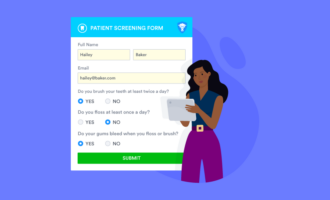
- Build branded, patient-friendly intake experiences quickly
- Use conditional logic to create smarter, shorter flows
- Test and iterate without waiting on development cycles
At the same time, everything runs within a secure, compliant environment, so you’re not trading experience for governance.
The result?
Intake stops being a bottleneck and starts becoming a scalable, high-performing part of your funnel.
The bottom line for marketing leaders
If you’re investing heavily in acquisition but losing patients during intake, you don’t have a traffic problem.
You have a friction problem.
But once you start treating intake like what it really is — a conversion experience — you unlock something powerful:
- Higher intake completion rates
- Stronger patient trust
- More efficient growth
Because the best-performing healthcare organizations don’t just optimize the front of the funnel.
They optimize what happens after the click.
And that’s where the real wins are.
—
Watch “Intake as infrastructure: A strategic framework for medical operations leaders” webinar.




























































































Send Comment: