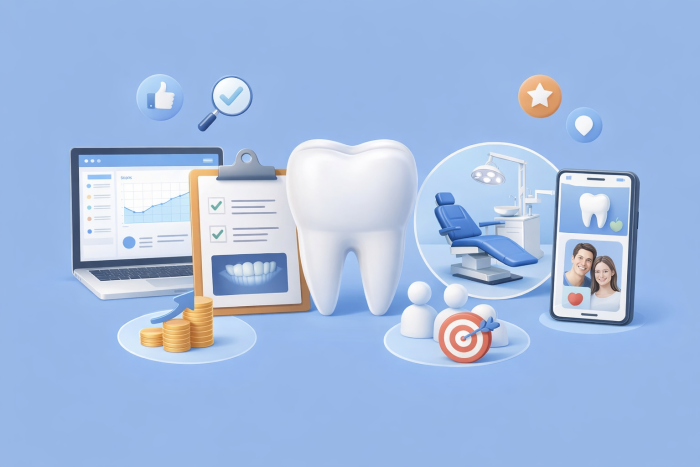
New patient acquisition is the lifeblood of a growing dental practice. But in a competitive local market, simply being good at dentistry is no longer enough to keep your chairs full. You need a deliberate, multichannel strategy for reaching prospective patients at the right moment, and a seamless experience that converts their interest into a booked appointment.
Here are seven proven strategies that leading dental practices use to grow their patient base, reduce acquisition costs, and build a pipeline that does not depend on any single source.
1. Dominate your local search results
When someone moves to a new city, starts a new job, or simply decides it is time to find a dentist, their first step is almost always a Google search. Appearing at the top of those local results, in the Google Map Pack and in organic listings, is the one of the most effective things you can do for new patient acquisition.
The foundation is a fully optimized Google Business Profile: accurate contact information, updated hours, high-quality photos of your office and team, and a compelling description of what makes your practice stand out. From there, build your local SEO through consistent directory listings, patient reviews, and website content that targets location-specific keywords.
Practices that rank in the top three local results for “dentist [city]” and related search terms report a disproportionate share of new patient inquiries. The investment in local SEO compounds over time — unlike paid advertising, the traffic does not stop when the budget does.
One way to strengthen your local presence further: Embed a new patient registration form directly on your website using Jotform Enterprise. When a prospective patient lands on your site from a local search, an accessible, branded form that captures their information and appointment preferences gives them an immediate next step — increasing the likelihood that they schedule a visit.
2. Make online booking non-negotiable
Most prospective patients will not call your office during business hours. They will look for your practice on a Tuesday evening, decide they want to book, and, if you do not offer online scheduling, close the tab and move on to a competitor who does.
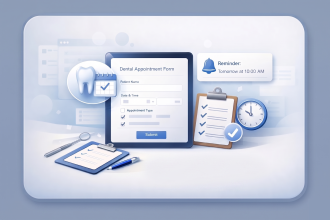
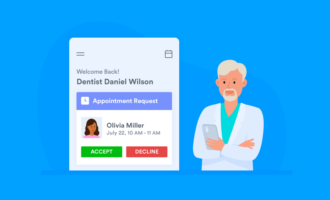
Online booking is now a baseline patient expectation, not a differentiator. Jotform Enterprise makes it straightforward to build a mobile-friendly appointment request form that can be embedded on any page of your website — your homepage, your services pages, or your Google Business Profile. Patients can complete it in minutes from any device, and your team receives an instant notification with all the details they need to confirm the appointment.
Because Jotform’s form builder requires no coding, your front office team can own and update the booking form directly — adjusting availability windows, adding new services, or updating provider options — without waiting on a developer. That agility matters when you are trying to keep pace with a competitive market.
3. Use paid search to capture high-intent patients
Google Ads and similar paid search platforms allow you to appear at the top of search results for specific high-intent queries like “emergency dentist near me,” “dental implants [city],” or “affordable family dentist [zip code].”
Unlike broad brand awareness campaigns, paid search targets patients who are actively searching for a provider. The conversion rates are significantly higher than display advertising because the intent is already there.
Start with a focused campaign targeting your highest-value services, implants, clear aligners, or cosmetic dentistry tend to have strong ROI for paid search. Set a geographic radius that realistically reflects your service area, and use call tracking to understand which ads are driving actual phone calls and appointments.
For paid search to perform, the post-click experience matters as much as the ad itself. If your ad lands patients on a generic homepage with no clear path to action, you are paying for traffic that does not convert. Building a dedicated Jotform landing page form for each high-intent campaign — a simple, focused form for implant consultations or cosmetic assessments, for example — gives your paid traffic a clear next step and significantly improves your cost per acquisition.
4. Activate your existing patient base for referrals
Your current patients are your most credible marketing channel. A recommendation from a trusted friend or family member carries far more weight than any advertisement — and referred patients tend to have higher retention rates and lifetime value than patients acquired through other channels.
Create a simple, structured referral program that gives patients a reason to spread the word. A thank-you gift, a credit toward their next service, or even a handwritten note of appreciation after a referred patient’s first visit can be enough to reinforce the behavior.
Do not rely on patients to refer spontaneously. With Jotform Enterprise, you can build a shareable referral form that patients can send directly to friends and family — capturing the referral source automatically when a new patient books. Pair this with Jotform’s automated notification workflows to trigger a thank-you message to the referring patient the moment their referral completes their first appointment. This makes the program feel responsive and personal, even when it is running on autopilot.
5. Build a review profile that converts
For most patients, reviews are the deciding factor between two practices that appear equally qualified on paper. A practice with 200 reviews and a 4.8-star average will consistently outperform a competitor with 12 reviews and a 4.9-star average, because volume signals trustworthiness at scale.
The key to building a strong review profile is consistency. Implement an automated review request process that sends a follow-up message to every patient after their appointment, with a direct link to Google or your preferred review platform. Make the process quick for patients — requiring only two taps from the message to a submitted review.
Jotform’s workflow automation functionality makes this easy to operationalize. Set up a post-appointment trigger that sends a satisfaction check-in — a brief, friendly Jotform feedback form — to every patient within 24 hours of their visit. When a patient completes the feedback form with a positive rating, follow up automatically with a link to leave a public review.
This two-step approach identifies satisfied patients before directing them to a review platform, resulting in a higher volume of positive reviews and giving your team a heads-up when a patient had a subpar experience before it becomes a public complaint.
Respond to every review — positive and negative. Thank patients who leave positive feedback by name (without referencing specific treatment details). Address negative reviews calmly, professionally, and with an invitation to resolve the issue directly.
6. Reduce drop-off with a frictionless intake experience
Here is a fact that surprises many practice owners: a significant portion of new patients who book an appointment never complete their first visit. Some simply do not show up. Others are put off by a long, confusing paper-based intake process that makes the practice feel outdated before care has even begun.
Your intake experience is part of your marketing. It signals the quality and modernity of your practice from the moment a new patient interacts with your systems. A smooth, digital intake process — one that patients can complete from their phone before they arrive — reduces no-shows, shortens wait times, and creates a strong first impression that increases the likelihood of a second appointment.
Jotform Enterprise makes it straightforward for dental practices to build customized, HIPAA-enabled intake forms with zero coding. Choose from purpose-built dental form templates — covering health history, insurance information, and patient demographics — and customize them to match your practice’s branding in minutes using the drag-and-drop builder. Add Jotform Sign to collect electronic signatures on consent forms and HIPAA acknowledgments within the same seamless flow. Patients receive a link before their appointment, complete everything on any device, and arrive ready to be seen.
The result: no clipboards, no manual data entry, no unnecessary delays, and a first impression that tells patients your practice takes their time seriously.
7. Stay top of mind with email and SMS marketing
Most dental patients visit twice a year. In between, they are not thinking about your practice, unless you give them a reason to. Email and SMS marketing keep your practice visible, build the relationship, and drive recall appointments that might otherwise lapse.
An effective dental communication calendar includes appointment reminders and confirmations, recall reminders for patients who are due for a cleaning, educational content and seasonal promotions, and post-appointment follow-ups that request reviews and referrals.
Jotform Enterprise’s automated notification and workflow features support this communication cadence directly. Appointment reminder emails can be triggered automatically based on form submission data. Post-appointment follow-ups, feedback requests, and appointment reminders can be sequenced into a workflow that runs in the background, ensuring no patient goes silent simply because your team did not have time to reach out.
The goal is not to flood patients with messages. It is to be consistently present and genuinely useful. Practices that communicate proactively with their patient base see significantly higher recall rates and lower attrition, and they give satisfied patients more reasons and more opportunities to refer.
Putting it all together
Effective dental patient acquisition is not about doing everything at once. It is about building a system — one where each channel reinforces the others, the patient journey is frictionless from search to seat, and your best existing patients are actively helping you grow.
Jotform Enterprise sits at the core of that system. From embeddable booking forms and HIPAA-enabled intake to automated follow-up workflows and patient satisfaction feedback, it gives your team the infrastructure to execute each of these seven strategies without adding complexity or overhead.
Start with the foundations: local SEO, online booking, and a consistent review-request process. Then layer in paid search for high-value services, a structured referral program, and proactive patient communication. And make sure the experience you deliver lives up to the impression you create, because marketing gets patients in the door, but operational excellence keeps them coming back.
—










Send Comment: